The Correct Answer and Explanation is:
Of course. Here is the correct categorization for each clause, followed by an explanation.
Independent Clauses
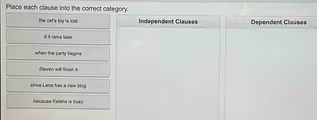
- the cat’s toy is lost
- Steven will finish it
Dependent Clauses
- if it rains later
- when the party begins
- since Lena has a new blog
- because Keisha is busy
Explanation
To correctly categorize these clauses, it is essential to understand the distinction between independent and dependent clauses. An independent clause, also known as a main clause, contains both a subject and a verb and expresses a complete thought. It can stand on its own as a grammatically correct sentence. A dependent clause, or subordinate clause, also has a subject and a verb, but it does not express a complete thought. It cannot stand alone as a sentence and must be joined to an independent clause to make sense.
The clauses “the cat’s toy is lost” and “Steven will finish it” are independent. The first clause has a subject (“the cat’s toy”) and a verb (“is lost”), and it conveys a complete idea. The second clause also has a subject (“Steven”) and a verb (“will finish”), forming a full statement. You can read each one by itself, and it functions as a complete sentence without needing any more information.
In contrast, the other four clauses are dependent. A key indicator of a dependent clause is that it often begins with a subordinating conjunction, a word that connects it to an independent clause and shows a relationship of time, cause, condition, or place. The clauses “if it rains later,” “when the party begins,” “since Lena has a new blog,” and “because Keisha is busy” all start with subordinating conjunctions (“if,” “when,” “since,” “because”). These words make the clauses incomplete. For instance, “if it rains later” presents a condition but leaves us asking, “then what will happen?” Similarly, “because Keisha is busy” gives a reason, but the result is missing. These clauses are fragments on their own and require an independent clause, such as “we will cancel the picnic,” to form a complete sentence.