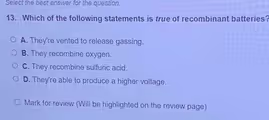
The Correct Answer and Explanation is:
The correct answer is B. They recombine oxygen.
A recombinant battery, more commonly known as a Valve-Regulated Lead-Acid (VRLA) battery, is designed to control the generation of gas during its charging cycle. This category includes both Absorbent Glass Mat (AGM) and Gel batteries.
The term “recombinant” refers to the specific chemical process that occurs inside the battery. During the charging of any lead-acid battery, the electrolysis of water in the electrolyte produces oxygen gas at the positive plates and hydrogen gas at the negative plates. In traditional flooded lead-acid batteries, these gases are simply vented into the atmosphere, which results in water loss and requires the user to periodically add distilled water.
In a recombinant battery, however, the system is sealed and designed to manage these gases internally. The oxygen gas produced at the positive plate is channeled to the negative plate. There, it reacts with the lead and sulfuric acid to reform water. This internal process, called the oxygen recombination cycle, effectively “recombines” the oxygen back into the electrolyte. This cycle is very efficient, preventing the loss of water and eliminating the need for regular maintenance.
Let’s look at why the other options are incorrect.
- A. They’re vented to release gassing. This is false. Recombinant batteries are sealed to prevent gassing and enable the recombination process. They do have safety valves that can release excess pressure if the battery is severely overcharged, but they are not vented for normal operation like a flooded battery.
- C. They recombine sulfuric acid. This is incorrect. Sulfuric acid is the electrolyte, a key component in the battery’s chemical reaction, but it is not the substance that is recombined. The recombination process involves oxygen and hydrogen, the components of water.
- D. They’re able to produce a higher voltage. This is also false. The fundamental electrochemistry of a lead-acid cell is the same whether it is a flooded or recombinant type. A single cell produces a nominal voltage of about 2.1 volts, so the overall battery voltage is determined by the number of cells, not the recombination feature.