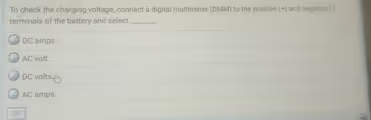
The Correct Answer and Explanation is:
The correct answer is DC volts.
To understand why this is the correct selection, it is important to break down the key terms in the question: “charging voltage,” “battery,” and “digital multimeter (DMM).”
First, a battery is a source of Direct Current (DC) power. This means that the electrical current flows in one consistent direction, from the positive terminal to the negative terminal. This is in contrast to Alternating Current (AC), the type of power typically supplied to homes and businesses, where the current periodically reverses direction. Since the task is to measure a characteristic of a battery, the multimeter must be set to a DC function. This immediately eliminates the “AC volt” and “AC amps” options.
Second, the question specifically asks to check the “voltage.” Voltage is the measure of electrical potential difference, or the “pressure” that pushes the electrical current through a circuit. It is measured in volts (V). Amperage, or “amps” (A), measures the current itself, which is the rate of flow of electric charge. The question is not about measuring the flow, but the electrical pressure. Therefore, any option involving “amps” is incorrect. This eliminates the “DC amps” option.
Combining these two points, the only logical choice is “DC volts.” When using a digital multimeter to measure the voltage of a battery (whether it’s resting or actively being charged), you must set the dial to the DC volts setting, often symbolized as V⎓. The procedure described, connecting the multimeter’s leads to the positive (+) and negative (-) terminals, is the standard method for measuring voltage in parallel with a component. Attempting to measure current this way by selecting “amps” would create a short circuit and likely blow a fuse in the multimeter or cause other damage.