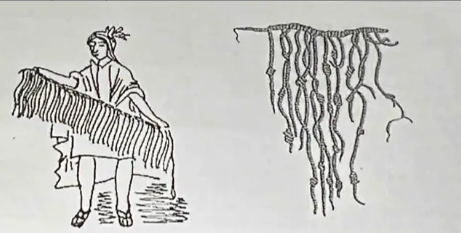
Which Mesoamerican civilization invented the quipu system pictured above? What was it used for?
The correct answer and explanation is:
The quipu system was invented by the Inca civilization, which was located in the Andean region of South America, primarily in present-day Peru. The quipu, which consists of a series of colored strings and knots, was used as a record-keeping system.
The Inca did not have a written language, so they developed the quipu to store and communicate information, primarily for administrative purposes. Each knot and string could represent numbers, and different types of knots indicated different numerical values. The color and length of the strings provided additional context, and the arrangement of the strings allowed for organization. For example, one string could represent a category, such as livestock, and the knots on that string could represent the number of animals.
In addition to numerical data, quipus may have been used for other types of information, such as recording historical events, census data, or even storing knowledge related to rituals. The Inca employed quipucamayocs, who were trained specialists in reading and making quipus. These experts were crucial to the administration of the vast Incan Empire, which required efficient management of resources, taxes, and military data.
Despite their importance, much of the quipu system remains a mystery. Scholars continue to study the quipus to decode more of their meanings, but much of the system has been lost due to the Spanish conquest, during which many quipus were destroyed. Some recent research suggests that the quipu may have also encoded non-numeric information, possibly even serving as a complex form of communication beyond mere numbers.