The Correct Answer and Explanation is:
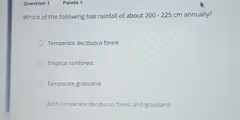
The correct answer is Tropical rainforest.
A biome’s characteristics, including its dominant plant and animal life, are primarily determined by its climate, specifically temperature and precipitation. The question asks to identify the biome that receives about 200 to 225 centimeters of rainfall annually. Analyzing the options reveals why the tropical rainforest is the only suitable choice.
Tropical rainforests, located in equatorial regions, are defined by their consistently high temperatures and abundant rainfall throughout the year. The annual precipitation in these biomes almost always exceeds 200 cm (around 80 inches) and can be much higher in some areas. Therefore, the 200-225 cm range falls squarely within the expected precipitation levels for a tropical rainforest. This vast amount of moisture supports the incredibly dense, lush vegetation and unparalleled biodiversity for which this biome is famous.
In contrast, the other options receive significantly less rainfall. The temperate deciduous forest, characterized by four distinct seasons, typically gets between 75 and 150 cm of precipitation annually. While this is enough to support large, broadleaf trees, it is considerably lower than the amount specified in the question.
Temperate grasslands are even drier, receiving only 25 to 75 cm of rain per year. This lower level of precipitation is a key limiting factor that prevents the growth of dense forests and instead favors the dominance of grasses and herbaceous plants.
Since neither the temperate deciduous forest nor the temperate grassland comes close to the 200-225 cm rainfall range, the final option suggesting both is also incorrect. Thus, the tropical rainforest is the only biome listed that fits the high precipitation criteria.