The Correct Answer and Explanation is:
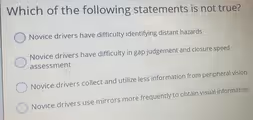
The correct answer is the fourth option: Novice drivers use mirrors more frequently to obtain visual information. This statement is not true.
In reality, the opposite is correct. Experienced drivers use their mirrors much more frequently and effectively than novice drivers. For someone new to driving, the core tasks of steering, accelerating, and braking consume a large amount of their mental focus. This high cognitive load often leads to a phenomenon known as “tunnel vision,” where the driver fixates on the road directly in front of the vehicle. As a result, they tend to neglect other critical inputs, including regular checks of their rearview and side-view mirrors. A common error for new drivers is failing to check their mirrors before slowing down, changing lanes, or turning, which is a key reason why developing a consistent scanning pattern is a major focus of driver education.
Conversely, an experienced driver has automated the basic mechanics of controlling the car. This frees up their mental capacity to engage in more sophisticated and comprehensive visual scanning. This well-practiced routine involves constantly moving their eyes from the road ahead, to their mirrors, and to their peripheral zones. This allows them to build and maintain a complete, 360-degree awareness of their surroundings, which is vital for anticipating the actions of other road users and reacting safely to potential hazards.
The other three statements accurately describe common difficulties for novice drivers. They do struggle with identifying distant hazards, have poor gap and closure speed judgment, and utilize less information from their peripheral vision. Therefore, the claim that new drivers use their mirrors more frequently is the one false statement among the choices.