The Correct Answer and Explanation is:
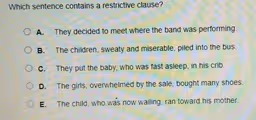
The correct answer is A. They decided to meet where the band was performing.
A restrictive clause provides essential information that is necessary to identify the noun or concept it modifies. If a restrictive clause is removed from a sentence, the core meaning of the sentence becomes unclear or changes significantly. A key grammatical feature of restrictive clauses is that they are not set off by commas.
In contrast, a non-restrictive clause provides additional, non-essential information. It can be removed from the sentence without altering the fundamental meaning. Non-restrictive clauses are always set off by commas.
Let’s analyze the options based on this distinction.
The correct sentence is A. They decided to meet where the band was performing. The clause “where the band was performing” is restrictive because it is essential for understanding the sentence. It specifies the exact location of the meeting. Without this clause, the sentence “They decided to meet” is incomplete and lacks the specific information intended. Notice that there are no commas separating the clause from the rest of the sentence.
Options C and E contain non-restrictive clauses. In sentence C, “who was fast asleep” is extra information about the baby. The main point, “They put the baby in his crib,” is clear without it. The commas correctly set this clause apart. Similarly, in sentence E, “who was now wailing” provides an additional detail about the child but is not needed to understand the main action, “The child ran toward his mother.” Again, the commas signal that this is non-essential information.
Options B and D do not contain clauses in the same way. “Sweaty and miserable” in sentence B is an adjectival phrase, and “overwhelmed by the sale” in sentence D is a participial phrase. While they function like non-restrictive elements by adding descriptive detail and being set off by commas, they are not clauses, and the information they provide is not essential. Therefore, sentence A is the only one that contains a true restrictive clause.