The Correct Answer and Explanation is:
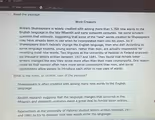
Based on the provided image, the correct answer is the third option.
Correct Answer: Researchers at the University of Helsinki studied letters written between 1417 and 1681 to try to discover how new words enter the language.
Explanation
This option best represents the central idea of the passage because the text is structured to introduce and detail this specific research. The passage’s primary function is to challenge a commonly held belief and present new evidence that offers an alternative explanation for language innovation.
The first paragraph serves as an introduction. It presents the popular idea that William Shakespeare was a prolific inventor of words but immediately suggests this might not be the complete story. This section sets the stage by posing a question: if not Shakespeare, then who was responsible for changing the language?
The entire second paragraph is dedicated to answering this question by presenting the findings of a specific study. It details the work of two linguists from the University of Helsinki, explaining their methodology, which involved analyzing sixty thousand letters from a specific historical period. It then presents their conclusion that young women, due to their extensive social connections, were the primary drivers of linguistic change.
The other options are incorrect for clear reasons. The first option, regarding Shakespeare, is merely the hook or starting point that the passage aims to move beyond. It is a supporting detail, not the main focus. The second option introduces the concept of “twenty first century writers,” a topic never mentioned in the passage, making it irrelevant.
Therefore, the statement describing the Helsinki research is the most accurate summary of the passage’s core content. The passage is fundamentally about this new research and its conclusions. While the ultimate thesis is that women were the true innovators, describing the study that proves this point captures the main subject matter that occupies the majority of the text and forms the basis of its argument.