The Correct Answer and Explanation is:
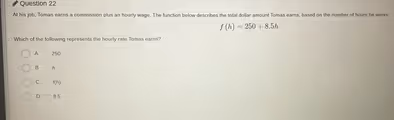
The correct answer is D. 8.5.
The problem provides a linear function, f(h) = 250 + 8.5h, to model the total amount of money Tomas earns. To find his hourly rate, we need to carefully analyze the components of this function and understand what each part represents in the context of his earnings.
This equation is structured like a standard linear equation, often written as y = mx + b. In this format, y is the total dependent value, x is the independent variable, m is the rate of change or slope, and b is the fixed starting amount or y intercept.
In the function provided, f(h) represents Tomas’s total earnings, which is the dependent value. The variable h represents the number of hours he works, which is the independent variable. The function is composed of two distinct parts that are added together: a constant value of 250 and a variable term of 8.5h.
The term 250 is a constant. This value does not change, regardless of how many hours Tomas works. The problem states that he earns a commission plus an hourly wage. Therefore, the 250 represents his fixed commission in dollars. He receives this amount as a base pay, even if he works zero hours.
The second term is 8.5h. This part of his earnings depends directly on h, the number of hours he works. The number 8.5 is the coefficient of h, which means it is the rate at which his earnings increase for each hour worked. For every single hour that Tomas works, his total pay increases by 8.5 dollars. This value represents his hourly wage.
The question specifically asks for the hourly rate. Based on this breakdown of the function, the hourly rate is the coefficient of the h variable, which is 8.5. Option A, 250, is the fixed commission. Option B, h, is the variable for the number of hours. Option C, f(h), represents the total earnings. Thus, the only choice that correctly represents the hourly rate is 8.5.