The Correct Answer and Explanation is:
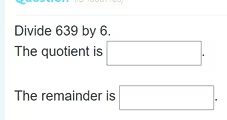
The quotient is 106.
The remainder is 3.
To solve the problem of dividing 639 by 6, we can use the method of long division. This process breaks down the division into a series of smaller, more manageable steps. The number being divided, 639, is called the dividend, and the number we are dividing by, 6, is the divisor.
First, we look at the first digit of the dividend, which is 6. We ask how many times the divisor, 6, can go into this digit. Since 6 divided by 6 is exactly 1, we write a 1 above the 6 in the dividend. This is the first digit of our quotient. We then multiply this 1 by the divisor 6, which gives us 6. We subtract this result from the first digit of the dividend: 6 minus 6 equals 0.
Next, we bring down the second digit of the dividend, which is 3, placing it next to the 0. Our new number to work with is 03, or simply 3. Now we ask how many times the divisor 6 can go into 3. Since 6 is larger than 3, it goes in zero times. We write a 0 as the next digit in our quotient. We multiply this 0 by the divisor 6, which is 0. We subtract this from 3: 3 minus 0 equals 3.
Finally, we bring down the last digit of the dividend, which is 9, placing it next to the 3. This gives us the number 39. We determine how many times 6 goes into 39 without exceeding it. By checking multiples of 6 (6 × 5 = 30, 6 × 6 = 36, 6 × 7 = 42), we see that 6 is the largest number of times. We write 6 as the final digit of our quotient. We multiply this 6 by the divisor 6, resulting in 36. We subtract this from 39: 39 minus 36 equals 3.
Since there are no more digits to bring down, the number 3 is our remainder. The final quotient is the number we formed above the dividend, which is 106.