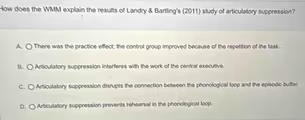
The Correct Answer and Explanation is:
The correct answer is D. Articulatory suppression prevents rehearsal in the phonological loop.
The Working Memory Model (WMM), proposed by Baddeley and Hitch, explains short term memory as a multi component system. The question refers to a specific component called the phonological loop, which processes auditory information. The phonological loop itself is subdivided into two parts: the phonological store (the “inner ear”), which holds sound based information for a very brief period, and the articulatory control process (the “inner voice”), which allows us to rehearse information to prevent it from decaying.
In the Landry & Bartling (2011) study, researchers aimed to test this model. They had two groups of participants. The control group was simply shown a list of phonologically dissimilar letters and asked to recall them in order. The experimental group was shown the same list but was also required to perform an articulatory suppression task, which involved repeating the numbers “1” and “2” out loud while viewing the letters.
The results showed that the experimental group’s ability to recall the letters was significantly worse than the control group’s. The WMM explains this finding through the disruption of the phonological loop. The articulatory suppression task of saying “1” and “2” overloaded the articulatory control process. Because this “inner voice” was occupied with the suppression task, it could not be used to subvocally rehearse the list of letters. Without this crucial rehearsal, the memory trace of the letters in the phonological store quickly decayed, leading to much poorer recall. This provides strong experimental support for the existence and function of the phonological loop as described in the Working Memory Model. The other options are incorrect because the primary interference is on the rehearsal mechanism of the phonological loop, not the central executive or other components.