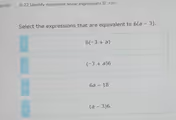
Of the choices provided, all four expressions are equivalent to 6(a – 3).
To determine which expressions are equivalent to 6(a – 3), we can apply fundamental properties of algebra. The original expression involves a number, 6, being multiplied by a group of terms in parentheses, (a – 3).
First, we can use the distributive property. This property states that multiplying a number by a group of terms is the same as multiplying the number by each term individually. Applying this to 6(a – 3), we multiply 6 by ‘a’ and 6 by ‘-3’. This gives us 6 * a – 6 * 3, which simplifies to 6a – 18. This directly confirms that the third option, 6a – 18, is equivalent.
Next, we can consider the commutative property of multiplication. This rule allows us to change the order of factors in a multiplication problem without changing the result. The original expression is 6 multiplied by the quantity (a – 3). According to this property, 6 * (a – 3) is the same as (a – 3) * 6. This confirms that the fourth option, (a – 3)6, is also equivalent.
We can also apply the commutative property of addition to the terms inside the parentheses. The expression ‘a – 3’ is mathematically the same as ‘a + (-3)’. The commutative property of addition lets us reorder these terms to ‘(-3) + a’, or simply ‘-3 + a’. Therefore, the quantity (a – 3) is equivalent to (-3 + a). If we substitute this back into the original expression, we get 6(-3 + a), which validates the first option.
Finally, by combining the commutative properties of both multiplication and addition, we can take the expression from the previous step, 6(-3 + a), and reorder the factors. This gives us (-3 + a)6, which confirms that the second option is also equivalent. All four options are mathematically identical to the original expression.