The Correct Answer and Explanation is:
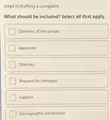
The correct selections for what should be included in a complaint are Request for damages and Caption.
A legal complaint is the foundational document that initiates a civil lawsuit. It must adhere to specific structural rules to be legally sufficient.
The Caption is a mandatory element that appears at the very top of the first page. It serves as the official heading for the case. The caption clearly identifies the court in which the lawsuit is filed, the names of the parties involved (the plaintiff and the defendant), the assigned case number, and the title of the document, which in this case is “Complaint.” Every document filed with the court throughout the litigation process must include this caption for proper identification and record keeping.
A Request for damages, also known as a “prayer for relief,” is another essential component. This section, typically located at the end of the complaint, explicitly states what the plaintiff is asking the court to award. This can include various forms of relief, such as monetary compensation for losses (compensatory damages), punishment for egregious conduct (punitive damages), or a court order requiring the defendant to perform a specific action or stop a certain behavior (injunctive relief). Without this request, the lawsuit would lack a defined objective, as the court and the defendant would not know what remedy the plaintiff seeks.
The other options are generally incorrect. A complaint should be based on factual allegations, not the subjective Opinions of the parties. While an Appendix or a Glossary might be included in highly complex cases with extensive exhibits or technical jargon, they are not standard or required elements of a basic complaint. Similarly, broad Demographic information is not required unless it is directly relevant to the legal claim, such as in an age or race discrimination case.