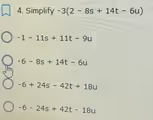
The Correct Answer and Explanation is:
The correct answer is the third option: -6 + 24s – 42t + 18u
To simplify the expression -3(2 – 8s + 14t – 6u), we need to use the distributive property. This mathematical rule states that a number outside a set of parentheses should be multiplied by every single term inside the parentheses. In this problem, the number outside is -3, and the terms inside are 2, -8s, +14t, and -6u.
Let’s break down the process step by step:
- Multiply -3 by the first term, 2.
-3 * 2 = -6 - Multiply -3 by the second term, -8s.
When multiplying two negative numbers, the result is positive.
-3 * (-8s) = +24s - Multiply -3 by the third term, +14t.
When multiplying a negative number by a positive number, the result is negative.
-3 * 14t = -42t - Multiply -3 by the fourth term, -6u.
Again, multiplying two negative numbers results in a positive number.
-3 * (-6u) = +18u
Now, we combine all these results to form the simplified expression. We assemble the new terms in order: -6, +24s, -42t, and +18u.
The final simplified expression is -6 + 24s – 42t + 18u.
This expression cannot be simplified further because there are no like terms to combine. Each variable (s, t, and u) is distinct, and there is only one constant term (-6). Comparing our result to the given choices, it perfectly matches the third option. The other options are incorrect because they either fail to distribute the -3 to all terms or make errors with the signs during multiplication.