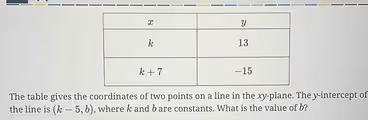
The Correct Answer and Explanation is:
Correct Answer: 33
To determine the value of b, we can use the fundamental property of a straight line: the slope between any two points on the line is constant. The problem provides us with three points that all lie on the same line: (k, 13), (k + 7, -15), and (k – 5, b).
First, let’s calculate the slope of the line using the two points given in the table. Let the first point be (x₁, y₁) = (k, 13) and the second point be (x₂, y₂) = (k + 7, -15). The formula for the slope, denoted by m, is the change in y divided by the change in x.
m = (y₂ – y₁) / (x₂ – x₁)
m = (-15 – 13) / ((k + 7) – k)
Calculating the numerator and the denominator separately gives us:
Numerator: -15 – 13 = -28
Denominator: (k + 7) – k = 7
Now, we can find the slope:
m = -28 / 7 = -4
So, the slope of the line is -4.
Next, since the point (k – 5, b) is also on this line, the slope between this point and any other point on the line must also be -4. Let’s use the first point from the table, (k, 13), and the third point, (k – 5, b).
Using the slope formula again with these two points:
m = (b – 13) / ((k – 5) – k)
The denominator simplifies to (k – 5 – k), which is -5. We can now set up an equation since we know the slope must be -4:
-4 = (b – 13) / -5
To solve for b, we multiply both sides of the equation by -5:
(-4) * (-5) = b – 13
20 = b – 13
Finally, we add 13 to both sides to isolate b:
20 + 13 = b
b = 33
Therefore, the value of b is 33. This method works without needing to determine the specific value of the constant k.