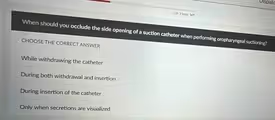
The Correct Answer and Explanation is:
Correct Answer: While withdrawing the catheter
Explanation:
The correct and safe procedure for performing oropharyngeal suctioning requires that suction is applied only during the withdrawal of the catheter. The side opening on a suction catheter, often called a thumb port, acts as a control valve. When this port is left open, suction is not actively pulling through the tip of the catheter.
This technique is a critical safety measure. Inserting the catheter into the delicate tissues of the oropharynx with active suction can cause significant harm. It can lead to the catheter tip adhering to the mucosal lining, causing trauma, bleeding, and pain for the patient. Furthermore, aggressive suctioning during insertion can stimulate the vagus nerve, potentially triggering a dangerous vasovagal response, which can result in a sudden drop in the patient’s heart rate and blood pressure.
The standard protocol is to first gently insert the catheter to the desired depth without covering the side port. Once the catheter is correctly positioned, you then occlude the port with your thumb to activate the suction. The catheter is then withdrawn using a continuous and gentle rotating motion. This twisting technique helps to clear secretions from the airway surfaces efficiently while minimizing the risk of causing damage to any single area of tissue.
The entire suctioning pass, from the moment suction is applied to when the catheter is completely removed, should be limited to a maximum of 10 to 15 seconds. This time constraint is essential to prevent hypoxia, as the suctioning process removes oxygen from the airway along with the targeted secretions. Therefore, applying suction exclusively during withdrawal is the established best practice that ensures patient safety and procedural effectiveness.