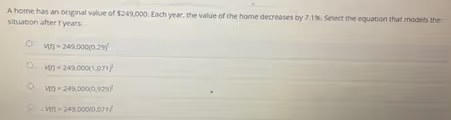
The Correct Answer and Explanation is:
The correct answer is V(t) = 249,000(0.929)^t.
This problem describes a situation of exponential decay, where an initial value decreases by a fixed percentage over regular time intervals. The general formula for exponential change is V(t) = P(1 + r)^t, where V(t) is the final value after time t, P is the initial principal amount, and r is the annual rate of change.
In this scenario, the initial value of the home, represented by P, is $249,000. The problem states that the value of the home decreases by 7.1% each year. This percentage is the rate of decay.
To use this rate in the formula, we must first convert it from a percentage to a decimal. We do this by dividing the percentage by 100:
7.1% = 7.1 / 100 = 0.071
Since the value is decreasing, the rate ‘r’ is negative, so r = -0.071.
Next, we calculate the expression inside the parentheses, (1 + r), which is known as the decay factor. This factor represents the percentage of the value that remains each year.
Decay Factor = 1 + r = 1 + (-0.071) = 1 – 0.071 = 0.929
This decay factor of 0.929 means that each year, the home’s value is 92.9% of its value from the previous year. This is equivalent to losing 7.1% of its value annually (100% – 92.9% = 7.1%).
Finally, we substitute the initial value (P = 249,000) and the decay factor (0.929) into the general exponential formula to model the situation after t years:
V(t) = 249,000(0.929)^t
This equation accurately represents the value of the home, V(t), after t years of depreciation.