The Correct Answer and Explanation is:
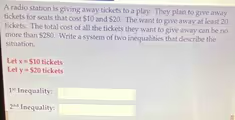
1st Inequality:
x + y ≥ 20
2nd Inequality:
10x + 20y ≤ 280
Explanation
To solve this problem, we need to translate the two conditions described in the text into mathematical inequalities. The problem defines our variables for us, where x represents the number of $10 tickets and y represents the number of $20 tickets.
The first condition states that the radio station wants to give away “at least 20 tickets.” The phrase “at least” means 20 is the minimum number, so the total number of tickets can be 20 or more. The total number of tickets is the sum of the $10 tickets (x) and the $20 tickets (y). Therefore, we can express this relationship using a “greater than or equal to” symbol (≥). This gives us our first inequality, which represents the constraint on the quantity of tickets: x + y ≥ 20.
The second condition concerns the total cost of the tickets, which “can be no more than $280.” The phrase “no more than” means the total cost can be exactly $280 or any amount less than that. To find the total cost, we multiply the number of each type of ticket by its price. The cost for the $10 tickets is 10 times x (10x), and the cost for the $20 tickets is 20 times y (20y). The total combined cost is 10x + 20y. Since this total must be less than or equal to $280, we use the “less than or equal to” symbol (≤). This gives us our second inequality, representing the budget constraint: 10x + 20y ≤ 280.
Together, these two inequalities form a system that accurately describes all the rules and limitations of the ticket giveaway scenario.