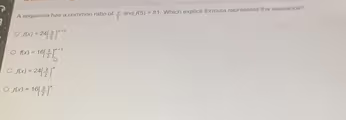
The Correct Answer and Explanation is:
The correct answer is B. f(x) = 16(3/2)^(x-1).
This problem asks for the explicit formula of a geometric sequence. A geometric sequence is a list of numbers where each term after the first is found by multiplying the previous one by a fixed, non-zero number called the common ratio. The standard explicit formula for a geometric sequence is f(x) = a * r^(x-1), where ‘a’ represents the first term of the sequence (f(1)), ‘r’ is the common ratio, and ‘x’ is the term number.
From the problem statement, we are given two key pieces of information: the common ratio (r) is 3/2, and the fifth term (f(5)) is 81. Our goal is to use this information to find the first term, ‘a’, and then construct the complete formula.
We begin by substituting the known values into the general formula. We have x = 5, f(5) = 81, and r = 3/2. Plugging these into the equation gives us:
81 = a * (3/2)^(5-1)
First, we simplify the exponent:
81 = a * (3/2)^4
Next, we calculate the value of (3/2) raised to the fourth power. This involves raising both the numerator and the denominator to the power of 4:
(3/2)^4 = 3^4 / 2^4 = 81 / 16
Now we substitute this value back into our equation:
81 = a * (81 / 16)
To solve for ‘a’, we need to isolate it. We can do this by dividing both sides of the equation by (81/16). Dividing by a fraction is the same as multiplying by its reciprocal, which is (16/81).
a = 81 * (16 / 81)
a = 16
Now that we have found the first term, a = 16, we can write the final explicit formula by substituting the values of ‘a’ and ‘r’ back into the general form:
f(x) = 16 * (3/2)^(x-1)
Comparing this result with the given choices, it perfectly matches option B. We can also verify this answer by plugging x = 5 back into our derived formula to ensure it yields the correct value of 81, which it does.