The Correct Answer and Explanation is:
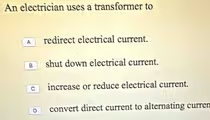
The correct answer is C: increase or reduce electrical current.
A transformer is a fundamental electrical device that operates on the principle of electromagnetic induction to change the voltage and current levels of an alternating current (AC) circuit. It does not create or destroy energy, but rather transfers it between two or more circuits.
The core function of a transformer is to alter AC voltage. It consists of two coils of wire, the primary coil and the secondary coil, wrapped around a common iron core. When an alternating voltage is applied to the primary coil, it generates a changing magnetic field in the core. This fluctuating magnetic field then induces an alternating voltage in the secondary coil.
According to the law of conservation of energy, the power in an ideal transformer’s primary coil must equal the power in its secondary coil. Power is calculated as the product of voltage and current (Power = Voltage × Current). This leads to a crucial inverse relationship between voltage and current.
If a transformer is designed to increase the voltage, it is called a step-up transformer. In this case, the secondary coil has more turns of wire than the primary coil. To keep the power constant, an increase in voltage must be accompanied by a proportional decrease in current.
Conversely, a step-down transformer is designed to decrease the voltage. It has fewer turns in the secondary coil than in the primary. This reduction in voltage results in a proportional increase in the available current.
For example, power is transmitted over long distances at very high voltages to minimize energy loss, which requires a step-up transformer at the power plant. Then, a series of step-down transformers are used to reduce the voltage to a safe, usable level for homes and businesses, which simultaneously increases the current available for appliances. Therefore, a transformer’s role is to increase or reduce voltage, which inherently causes it to reduce or increase electrical current.