The Correct Answer and Explanation is:
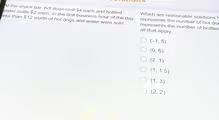
The correct answers are (2, 1) and (1, 3).
Here is an explanation of the solution.
To solve this problem, we first need to create a mathematical inequality based on the information given. Let ‘x’ represent the number of hot dogs sold and ‘y’ represent the number of bottled waters sold. Since each hot dog costs $4 and each bottle of water costs $2, the total cost can be represented by the expression 4x + 2y. The problem states that the total sales were “less than $12”. This translates to the inequality 4x + 2y < 12.
In addition to this inequality, we must consider the real world context of the problem. The variables x and y represent the number of items sold, which means they must be whole, non-negative numbers. It is impossible to sell a negative number of hot dogs or a fraction of a water bottle.
Now we can test each ordered pair (x, y) to see if it meets both conditions: the inequality and the real world constraints.
- (-1, 5): This is not a reasonable solution because x is negative. A snack bar cannot sell -1 hot dogs.
- (0, 6): Let’s check the inequality. 4(0) + 2(6) = 0 + 12 = 12. Since 12 is not less than 12, this option is incorrect. The total cost must be strictly less than $12.
- (2, 1): The numbers are whole and non negative. Let’s check the inequality. 4(2) + 2(1) = 8 + 2 = 10. Since 10 is less than 12, this is a correct solution.
- (1, 1.5): This is not a reasonable solution because y is not a whole number. A snack bar cannot sell 1.5 bottles of water.
- (1, 3): The numbers are whole and non negative. Let’s check the inequality. 4(1) + 2(3) = 4 + 6 = 10. Since 10 is less than 12, this is a correct solution.
- (2, 2): Let’s check the inequality. 4(2) + 2(2) = 8 + 4 = 12. Similar to the (0, 6) option, 12 is not less than 12, so this option is incorrect.