The Correct Answer and Explanation is:
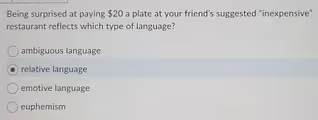
The correct answer is relative language.
Relative language consists of words that gain their meaning through comparison. Terms like “fast,” “slow,” “big,” “small,” “smart,” or “easy” do not have precise, objective definitions. Instead, their meaning is dependent on the context and the point of reference of the person using them.
In the scenario presented, the word “inexpensive” is a classic example of a relative term. There is no universal standard or fixed dollar amount that defines what is considered inexpensive. The meaning is entirely subjective and changes from person to person based on their individual experiences, financial situation, and expectations. For the friend who suggested the restaurant, a $20 plate might seem very reasonable, or even a bargain, compared to other places they frequent where meals could cost significantly more. In their personal frame of reference, $20 is inexpensive.
However, for the person who was surprised by the bill, their standard for an “inexpensive” meal might be a price point closer to $10 or $15. Their surprise stems directly from this difference in perspective. The two friends have different benchmarks for what constitutes an inexpensive meal, leading to a communication breakdown. This misunderstanding is not due to the word being ambiguous with multiple distinct meanings, nor is it an emotional term or a euphemism. The problem lies entirely in the word’s relative nature, which requires a shared understanding of the comparison point to be effective. The surprise perfectly illustrates the pitfalls of using relative language without first establishing a common ground.