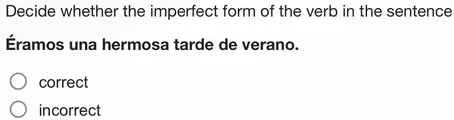
The Correct Answer and Explanation is:
The correct answer is incorrect.
The use of the imperfect verb form “Éramos” in the sentence “Éramos una hermosa tarde de verano” is incorrect. This sentence literally translates to “We were a beautiful summer afternoon.” The core issue is a grammatical disagreement between the subject of the verb and the description that follows.
The verb “Éramos” is the first person plural imperfect form of the verb “ser” (to be). The subject for “Éramos” is “nosotros” or “nosotras,” which means “we.” This subject refers to a group of people. However, the rest of the sentence, “una hermosa tarde de verano” (a beautiful summer afternoon), describes a time, a setting, or the weather. It is not possible for a group of people (“we”) to be an afternoon. This creates a logical and grammatical contradiction.
The correct way to express this idea in Spanish would be to use the third person singular imperfect form of “ser,” which is “Era.” The sentence should be “Era una hermosa tarde de verano.” This translates to “It was a beautiful summer afternoon.” In this corrected version, the verb “Era” agrees with an impersonal subject (“it”), which properly corresponds with the description of the afternoon.
While the imperfect tense itself is the correct choice for describing a past setting or providing background information, the specific conjugation used in the original sentence is wrong. The imperfect tense effectively sets a scene, describing ongoing conditions in the past. However, the verb must always agree with its subject. In this case, the intended subject is the day or the time, not a group of people, making “Éramos” the incorrect conjugation for this context.