The Correct Answer and Explanation is:
The correct answers are:
5
10
1
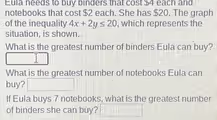
The problem describes Eula’s shopping trip with a budget of $20. Binders cost $4 each, and notebooks cost $2 each. This situation is represented by the inequality 4x + 2y ≤ 20, where x is the number of binders and y is the number of notebooks. The inequality shows that the total amount spent on binders (4x) plus the total amount spent on notebooks (2y) must be less than or equal to her $20 budget.
To find the greatest number of binders Eula can buy, we assume she spends all her money on binders and buys zero notebooks. In the inequality, we set y to 0. This gives us 4x + 2(0) ≤ 20, which simplifies to 4x ≤ 20. Dividing both sides by 4, we find that x ≤ 5. Therefore, the greatest number of binders she can purchase is 5.
Similarly, to find the greatest number of notebooks she can buy, we assume she buys zero binders. We set x to 0 in the inequality. This gives us 4(0) + 2y ≤ 20, which simplifies to 2y ≤ 20. When we divide both sides by 2, we get y ≤ 10. This means the maximum number of notebooks she can buy is 10.
For the final question, we are told Eula buys 7 notebooks. We can calculate the cost of these notebooks, which is 7 multiplied by $2, for a total of $14. We substitute y = 7 into the inequality to find out how many binders she can afford with her remaining money. The inequality becomes 4x + 2(7) ≤ 20, or 4x + 14 ≤ 20. Subtracting 14 from both sides gives 4x ≤ 6. Dividing by 4 gives x ≤ 1.5. Since Eula cannot buy half a binder, the greatest whole number of binders she can buy is 1.