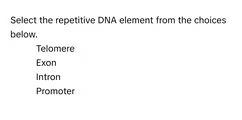
The Correct Answer and Explanation is:
The correct answer is Telomere.
A telomere is a region of repetitive nucleotide sequences located at each end of a linear chromosome. It is a quintessential example of a repetitive DNA element. In humans and other vertebrates, the specific sequence that is repeated is TTAGGG. This short sequence is repeated hundreds or even thousands of times in tandem, forming a long, non-coding cap at the chromosome’s tip.
The primary function of this repetitive structure is to protect the ends of chromosomes from being mistaken for broken DNA by the cell’s repair machinery and to prevent them from fusing with other chromosomes. Furthermore, telomeres are crucial for solving the “end replication problem.” During DNA replication, the cellular machinery cannot fully copy the very end of the lagging strand, which would cause chromosomes to become progressively shorter with each cell division, eventually leading to the loss of essential genetic information. The repetitive, non-coding nature of telomeres means that they can be gradually shortened over many cell cycles without affecting the genes themselves, thus acting as a protective, disposable buffer.
In contrast, the other options are not primarily defined as repetitive DNA elements:
- Exons are the coding regions of a gene that are translated into protein. Their DNA sequences are highly specific and complex, not simple repeats.
- Introns are non-coding regions within a gene that are spliced out of the messenger RNA before translation. While introns can sometimes contain repetitive sequences, their defining characteristic is being an intervening sequence, not a large, tandemly repeated structure like a telomere.
- Promoters are regulatory regions of DNA that initiate gene transcription. They contain specific short sequence motifs that bind to proteins, but the entire region is not a large repetitive element.