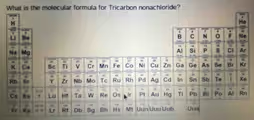
The Correct Answer and Explanation is:
The correct molecular formula for Tricarbon nonachloride is C₃Cl₉.
This formula is determined by following the systematic nomenclature rules for binary covalent compounds, which are molecules formed between two different nonmetal elements. The name of the compound provides all the information needed to write its chemical formula. The periodic table in the image confirms that both Carbon (C) and Chlorine (Cl) are nonmetals, so this naming system is appropriate.
The process involves breaking down the name into its constituent parts:
- Prefixes and Elements: In covalent nomenclature, Greek prefixes are used to indicate the number of atoms of each element in the molecule. The first part of the name is “Tricarbon.” The prefix “tri” means three. “Carbon” is the name of the element with the chemical symbol C. Therefore, “Tricarbon” tells us there are three carbon atoms in the molecule. This is written as C₃.
- Second Element: The second part of the name is “nonachloride.” The prefix “nona” means nine. The root word “chlor” refers to the element chlorine, with the chemical symbol Cl. The suffix “-ide” is conventionally added to the end of the second element’s name in a binary compound. Thus, “nonachloride” indicates that there are nine chlorine atoms present. This is written as Cl₉.
- Assembling the Formula: To write the complete molecular formula, you combine the symbols for each element with their respective subscripts. The order of the elements in the formula typically follows the order they are given in the name, which usually places the less electronegative element first. Carbon is less electronegative than chlorine, so it comes first. By combining the two parts we derived, C₃ and Cl₉, we get the final molecular formula: C₃Cl₉.