The Correct Answer and Explanation is:
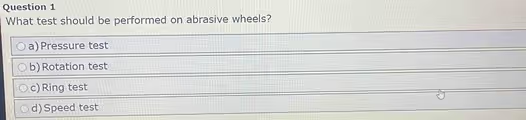
The correct answer is c) Ring test.
The ring test is an essential and universally recognized safety inspection performed on vitrified and silicate abrasive wheels before they are mounted on a grinder. Its purpose is to detect hidden cracks or internal structural damage that may not be visible to the naked eye. Abrasive wheels rotate at very high speeds, generating immense centrifugal force. If a wheel with an unseen crack is put into service, it can shatter catastrophically during operation, ejecting sharp fragments with lethal force. Therefore, performing a ring test is a critical step in preventing serious workplace accidents.
To conduct a ring test, the wheel should be dry, clean, and free from any packaging. It is then tapped gently with a light, non-metallic object like a plastic screwdriver handle or a wooden mallet. For smaller wheels, they can be suspended from a finger or a small pin through the center hole. The wheel should be tapped in at least four places, approximately 45 degrees on each side of the vertical centerline and about one to two inches from the edge.
A sound, undamaged wheel will emit a clear, metallic ringing sound, indicating its structural integrity. This is where the test gets its name. Conversely, a wheel that is cracked or has an internal flaw will produce a dull thud, a buzz, or a dead sound. If any sound other than a clear ring is heard, the wheel is deemed unsafe and must be immediately discarded and destroyed to prevent accidental use. While a “speed test” is also a vital safety check, it is performed by the manufacturer to determine the maximum safe operating speed, not by the end user. A “pressure test” is not applicable to solid wheels. The ring test is the specific, non-destructive inspection every operator should perform.