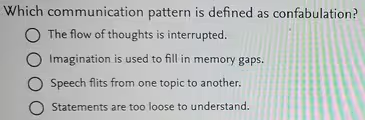
The Correct Answer and Explanation is:
The correct answer is: Imagination is used to fill in memory gaps.
Confabulation is a fascinating and complex communication and memory pattern observed in individuals with certain neurological conditions. It is defined as the unintentional creation of fabricated, distorted, or misinterpreted memories to fill in gaps in one’s memory. A crucial aspect of confabulation is that the individual is not consciously trying to deceive or lie. They genuinely believe these false memories are accurate and true accounts of their past. This process is an unconscious attempt by the brain to construct a coherent narrative in the face of significant memory loss.
The content of these fabricated memories can vary widely. Sometimes they are plausible stories constructed from fragments of real memories that are misplaced in time or context. In other cases, they can be bizarre or fantastical. For example, a person with Korsakoff’s syndrome might, when asked what they did yesterday, confidently recount a detailed story about going to the park, even if they have not left their hospital room for weeks. They are not lying; their brain has simply generated a story to fill the void where the memory of yesterday should be.
This communication pattern is distinct from other thought disorders. It is not an interruption in the flow of thought, which is known as thought blocking. It is also different from flight of ideas, where speech rapidly shifts between loosely connected topics, or loose associations, where the connections between ideas are illogical and difficult to follow. Confabulation is specifically a disorder of memory content, not thought process or flow. It is most commonly associated with conditions that affect the brain’s memory centers, such as Korsakoff’s syndrome, Alzheimer’s disease, traumatic brain injury, or stroke. Understanding confabulation is vital for caregivers and healthcare professionals to provide compassionate and effective care, recognizing it as a symptom of a neurological deficit rather than a behavioral issue.