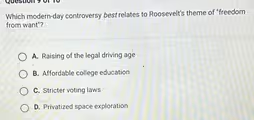
The Correct Answer and Explanation is:
The correct answer is B. Affordable college education.
Franklin D. Roosevelt introduced the concept of “freedom from want” in his 1941 State of the Union address. This freedom refers to economic security, ensuring that all people have access to the basic necessities for a healthy and decent life, such as food, clothing, housing, and healthcare. It is the right to be free from poverty and to possess a standard of living that supports well being. The principle underpins many social safety net programs, like Social Security, that were established to protect citizens from economic hardship.
The modern controversy over affordable college education directly relates to this theme. In today’s economy, a college degree is often considered a crucial pathway to achieving economic stability and securing a well paying job. However, the rapidly rising cost of higher education has become a significant financial barrier for many individuals and families. The burden of student loan debt can delay or prevent graduates from buying homes, starting families, and building wealth, effectively trapping them in a state of financial precarity.
The debate about making college more affordable, whether through government subsidies, loan forgiveness programs, or tuition free models, is fundamentally a discussion about economic opportunity and security. Proponents argue that access to education should not be determined by a person’s financial background and that an educated populace benefits society as a whole by fostering innovation and a stronger workforce. This aligns perfectly with Roosevelt’s vision of a society where every person has the means to achieve economic wellness and is free from the crushing weight of want. The other options are less relevant; driving age is a public safety issue, voting laws concern civil rights, and space exploration is a matter of scientific and industrial policy.