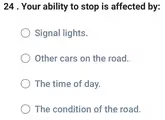
The Correct Answer and Explanation is:
The correct answer is: The condition of the road.
Your ability to stop a vehicle safely is determined by your total stopping distance. This distance is a combination of your perception and reaction time, which is the time it takes to see a hazard and apply the brakes, and the vehicle’s braking distance, which is the distance the car travels after the brakes are applied. While several factors influence this process, the condition of the road has the most direct and significant impact on your vehicle’s physical ability to stop.
The key to braking is the friction between your tires and the road surface. Excellent road conditions, such as clean, dry pavement, provide maximum friction, allowing your vehicle to stop in the shortest possible distance. However, adverse road conditions drastically reduce this friction. For instance, roads that are wet, icy, or covered in snow will significantly increase your braking distance because the tires have less grip. A vehicle might take more than double the distance to stop on a wet road and up to ten times the distance on an icy road compared to dry pavement. Similarly, loose surfaces like gravel or dirt also reduce tire traction and lengthen the distance required to come to a halt.
Let’s consider the other options. Signal lights tell you when to stop, but they do not affect the physical process of stopping. Other cars on the road are hazards that necessitate stopping, but they don’t change your car’s braking performance. The time of day can affect your visibility, which might increase your reaction time, but the condition of the road itself directly governs the fundamental physics of how effectively your brakes can work. Therefore, the road’s condition is the most critical factor listed that affects your stopping ability.