The correct answer and explanation is:
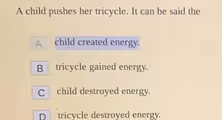
The correct answer is B: tricycle gained energy.
This scenario is a classic illustration of the fundamental principles of work and energy, governed by the Law of Conservation of Energy. This law states that energy cannot be created or destroyed; it can only be transferred from one object to another or converted from one form to another.
When the child pushes the tricycle, she is doing “work” on it in the physical sense. Work is defined as applying a force to an object that causes it to move over a distance. The ability to do work requires energy. The child has chemical potential energy stored in her muscles from the food she has eaten. To push the tricycle, she converts this internal chemical energy into mechanical energy. This mechanical energy is then transferred from her to the tricycle through the act of pushing.
The tricycle, which was initially at rest, had zero kinetic energy, which is the energy of motion. As the child performs work on it, this transferred energy causes the tricycle to start moving. Because it is now in motion, the tricycle possesses kinetic energy. Therefore, the tricycle has gained energy from the child. The energy was not created from nothing; it was simply moved from the child’s system to the tricycle’s system.
This analysis shows why the other options are incorrect. Options A and C, which state that the child created or destroyed energy, are direct violations of the Law of Conservation of Energy. The child is an energy transformer, not a creator or destroyer. Option D is also incorrect because the tricycle is the object receiving the energy. While some of the transferred energy will be converted into heat due to friction with the ground and air, this is another energy transformation, not a destruction of energy. The core event is the transfer of energy to the tricycle, resulting in its motion.