The Correct Answer and Explanation is:
The correct answer is 11.
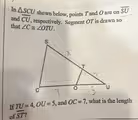
This geometry problem is solved by establishing that the two triangles in the diagram, the large triangle ΔSCU and the smaller triangle ΔOTU, are similar. Two triangles are considered similar if their corresponding angles are congruent and the ratio of their corresponding sides is equal.
We can prove the triangles are similar using the Angle-Angle (AA) Similarity Postulate. First, the problem states that angle C is congruent to angle OTU (∠C ≅ ∠OTU). This gives us one pair of congruent angles. Second, both triangles share angle U. In other words, angle SUC in the large triangle is the same as angle TUO in the small triangle. Since two angles of ΔSCU are congruent to two angles of ΔOTU, the triangles are similar. We write this relationship as ΔSCU ~ ΔOTU, ensuring the corresponding vertices are in the correct order.
Because the triangles are similar, the ratios of their corresponding sides must be equal. We can set up a proportion:
(Side SU) / (Side OU) = (Side CU) / (Side TU)
Next, we substitute the known values into this equation. The length of side CU is the sum of the lengths of OC and OU, which is 7 + 5 = 12. The length of side SU is the sum of the unknown length ST and the length of TU, so we can write it as ST + 4. The lengths of OU and TU are given as 5 and 4, respectively.
Substituting these values into our proportion gives:
(ST + 4) / 5 = 12 / 4
We can simplify the right side of the equation:
(ST + 4) / 5 = 3
To solve for ST, we multiply both sides of the equation by 5:
ST + 4 = 15
Finally, we subtract 4 from both sides to isolate ST:
ST = 11
Therefore, the length of the segment ST is 11.