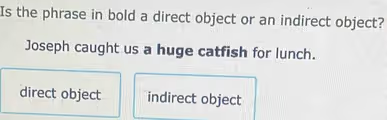
The Correct Answer and Explanation is:
The correct answer is direct object.
A direct object is a noun, pronoun, or phrase that directly receives the action of a transitive verb. To identify a direct object in a sentence, you can ask the question “what?” or “whom?” after the subject and the verb.
Let’s analyze the sentence: “Joseph caught us a huge catfish for lunch.”
First, identify the subject and the verb. The subject, who is performing the action, is “Joseph.” The action, or the verb, is “caught.”
Now, ask the question: “Joseph caught what?” The answer is “a huge catfish.” Because “a huge catfish” answers this question, it is the direct object. It is the thing that was directly affected by the action of being caught.
To further clarify, let’s identify the other parts of the sentence. The sentence also contains an indirect object. An indirect object is the recipient of the direct object and answers the question “to whom?” or “for whom?” the action was performed. If we ask, “For whom did Joseph catch a huge catfish?” the answer is “us.” Therefore, “us” is the indirect object.
In English grammar, when a sentence has both a direct and an indirect object, the indirect object often comes before the direct object, following the pattern: Subject + Verb + Indirect Object + Direct Object. This is exactly the structure we see in the sentence: “Joseph” (Subject) + “caught” (Verb) + “us” (Indirect Object) + “a huge catfish” (Direct Object).
The phrase “for lunch” is a prepositional phrase that acts as an adverb, explaining why the catfish was caught, but it does not change the function of the objects. Since the bolded phrase “a huge catfish” is the thing that was caught, it serves as the direct object of the verb.