The Correct Answer and Explanation is:
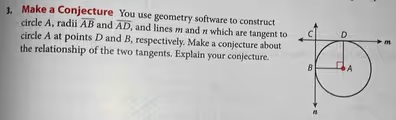
Conjecture: The tangent lines m and n are perpendicular to each other.
Explanation:
The relationship between the two tangent lines can be determined by analyzing the geometric figure formed by the radii and the tangents. A fundamental property of circles states that a radius drawn to a point of tangency is always perpendicular to the tangent line at that specific point.
In the given construction, radius AD is connected to the point of tangency D on line m. Therefore, line m is perpendicular to radius AD, which creates a 90-degree angle. Similarly, radius AB is connected to the point of tangency B on line n. This means line n is perpendicular to radius AB, also forming a 90-degree angle. The diagram visually confirms these right angles.
The diagram also shows that the two radii, AB and AD, are themselves constructed to be perpendicular. This establishes a third 90-degree angle at the center of the circle, A.
These points and lines create a quadrilateral, which can be labeled ACBD if we name the intersection of lines m and n as point C. The sum of the interior angles of any quadrilateral is always 360 degrees. We already know three of the four angles in the quadrilateral ACBD: the angle at vertex D is 90 degrees, the angle at vertex B is 90 degrees, and the angle at vertex A is 90 degrees.
We can solve for the fourth angle, which is the angle at vertex C formed by the intersection of the two tangent lines. The calculation is as follows:
Angle at C = 360° – (Angle at A + Angle at B + Angle at D)
Angle at C = 360° – (90° + 90° + 90°)
Angle at C = 360° – 270°
Angle at C = 90°
Since the angle formed by the intersection of lines m and n is 90 degrees, the lines are by definition perpendicular. Furthermore, because all four interior angles are 90 degrees and the adjacent sides AB and AD are equal in length (as they are both radii), the quadrilateral ACBD is a square.