The Correct Answer and Explanation is:
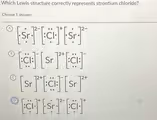
The correct answer is B.
The provided image asks for the correct Lewis structure for strontium chloride. To determine this, we must first understand the nature of the bond between strontium (Sr) and chlorine (Cl). Strontium is an alkaline earth metal in Group 2 of the periodic table, and chlorine is a halogen in Group 17. The combination of a metal and a nonmetal typically results in an ionic bond, which involves the transfer of electrons, not the sharing seen in covalent bonds.
First, let’s consider the ions that each element will form to achieve a stable electron configuration, resembling that of a noble gas.
Strontium (Sr) has two valence electrons. To become stable, it will lose these two electrons, forming a cation with a positive two charge. This ion is represented as Sr²⁺. In a Lewis structure, the cation is shown as the element’s symbol in brackets with the charge as a superscript, and no valence dots are drawn because it has lost its valence shell. So, the strontium ion is written as [Sr]²⁺.
Chlorine (Cl) has seven valence electrons. To achieve a stable octet, it needs to gain one electron. By gaining one electron, it forms an anion with a negative one charge. This ion, the chloride ion, is represented as Cl⁻. In a Lewis structure, the anion is shown as the element’s symbol surrounded by eight dots (representing a full valence shell), enclosed in brackets, with its charge as a superscript. The chloride ion is written as [:Cl:]⁻.
To form a neutral ionic compound, the total positive charge must balance the total negative charge. Since one strontium ion has a +2 charge and one chloride ion has a -1 charge, two chloride ions are needed to balance the charge of one strontium ion. This results in the chemical formula SrCl₂.
Therefore, the correct Lewis structure must show one strontium cation, [Sr]²⁺, and two chloride anions, [:Cl:]⁻. Option B, which shows [:Cl:]⁻ [Sr]²⁺ [:Cl:]⁻, accurately represents this arrangement. The other options are incorrect because they show incorrect charges on the ions (A, C, D) or an incorrect stoichiometry (C).