The correct answer and explanation is:
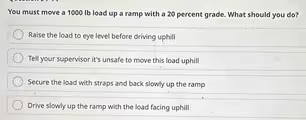
The correct answer is: Tell your supervisor it’s unsafe to move this load uphill.
Here is a detailed explanation:
The most critical aspect of operating a forklift or any powered industrial truck is safety. The question presents a scenario with an extreme hazard: a 20 percent grade. This is an exceptionally steep incline for such equipment, and attempting to navigate it with a 1000 lb load poses a severe risk of a backward tip-over, which can be fatal for the operator.
A 20 percent grade means that for every 10 feet traveled horizontally, the ramp rises 2 feet vertically. When a forklift operates on an incline, its center of gravity shifts. Driving uphill with a load causes the combined center of gravity of the truck and the load to move backward, closer to the rear axle. On a grade as steep as 20 percent, this shift is so significant that it can easily lift the front wheels off the ground, causing the entire machine to flip over backward.
Most forklift manufacturers specify a maximum grade capacity for their equipment, which is often 15 percent or less. Exceeding this limit is a direct violation of safe operating procedures. Therefore, the operator’s primary responsibility is to recognize that the task is unsafe. The most appropriate and professional action is to stop the work, identify the hazard, and report it to a supervisor. This allows for a reevaluation of the task and the implementation of a safer method, such as using a crane, a different route, or equipment better suited for such a steep incline.
The other options are incorrect because they are extremely dangerous. Raising the load to eye level makes the forklift top heavy and far more unstable. Backing up the ramp with the load would place the load on the downhill side, making a backward tip over almost certain. While driving slowly with the load facing uphill is the correct technique for a safe incline, it does not negate the inherent danger of a 20 percent grade, which is likely beyond the machine’s design limits.