The Correct Answer and Explanation is:
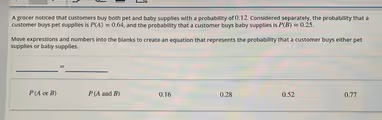
P(A or B) = 0.77
To determine the probability that a customer buys either pet supplies or baby supplies, we need to calculate the probability of the union of two events. Let’s define the events based on the information provided:
- Let A be the event that a customer buys pet supplies. We are given P(A) = 0.64.
- Let B be the event that a customer buys baby supplies. We are given P(B) = 0.25.
- The event that a customer buys both pet and baby supplies is the intersection of A and B. We are given P(A and B) = 0.12.
The question asks for the probability that a customer buys either pet supplies or baby supplies. In probability notation, this is represented as P(A or B).
To find this probability, we use the General Addition Rule for probability, which states:
P(A or B) = P(A) + P(B) – P(A and B)
This formula adds the individual probabilities of each event and then subtracts the probability of both events occurring together. We subtract P(A and B) because the customers who buy both have been counted once in P(A) and again in P(B), so we must remove this overlap to avoid double-counting.
Now, we can substitute the given values into the formula:
P(A or B) = 0.64 + 0.25 – 0.12
First, sum the probabilities of the individual events:
0.64 + 0.25 = 0.89
Next, subtract the probability of the intersection:
0.89 – 0.12 = 0.77
Therefore, the probability that a customer buys either pet supplies or baby supplies is 0.77. The complete equation representing this is P(A or B) = 0.77.