The Correct Answer and Explanation is:
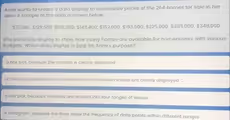
Correct Answer: A histogram, because it can show the frequency of data points within different ranges.
Explanation:
The most suitable data display for Ann’s purpose is a histogram. The core of her task is to understand how many homes fall into various price brackets so she can efficiently help homebuyers with different budgets. A histogram is specifically designed for this type of analysis.
The data Ann is working with, home prices, is quantitative and continuous. To make sense of 264 individual prices, she needs to group them. A histogram accomplishes this by dividing the entire range of home prices into a series of equal, continuous intervals, often called bins. For example, she could create bins for prices from $100,000 to $124,999, $125,000 to $149,999, and so on. The chart then displays a bar for each bin, where the height of the bar represents the frequency, or the exact number of homes, whose prices fall within that specific interval. This visual representation would immediately show Ann which price ranges have the most or fewest available homes, allowing her to advise clients effectively.
Other types of charts are less suitable. A box plot would provide a summary of the data, showing the median, quartiles, and range, but it would not reveal the number of homes within specific price brackets. A homebuyer with a budget of $150,000 would not know from a box plot how many options are actually available near their price point. A line plot is typically used to show trends over time, which is not relevant here. A bar graph is used for comparing discrete categories, not for displaying the distribution of continuous data like prices. Therefore, the histogram is the only option that directly visualizes the frequency of homes across different budget ranges, making it the perfect tool for Ann’s objective.