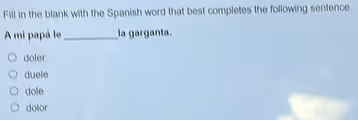
The Correct Answer and Explanation is:
The correct answer is duele.
The completed sentence is: “A mi papá le duele la garganta.” This translates to “My dad’s throat hurts” or “My dad has a sore throat.”
Here is a detailed explanation of why “duele” is the correct choice:
In Spanish, the verb “doler,” which means “to hurt” or “to ache,” functions in a way that can be different from English. It is a “gustar-like” verb. This means that the thing causing the pain is the grammatical subject of the sentence, and the person experiencing the pain is the indirect object.
Let’s break down the sentence structure:
- The Subject: The subject of this sentence is “la garganta” (the throat). This is the thing that is causing the pain. Since “la garganta” is a singular noun, the verb must be in the third-person singular form.
- The Verb: The verb “doler” needs to be conjugated to agree with the singular subject, “la garganta.” The correct third-person singular, present tense conjugation of “doler” is “duele.” If the subject were plural, for example, “los pies” (the feet), the verb would be “duelen.”
- The Indirect Object: The person who is feeling the pain is “mi papá” (my dad). In this type of sentence, the person is introduced with the preposition “a” (“A mi papá”). This part of the sentence is the indirect object.
- The Indirect Object Pronoun: The word “le” is the mandatory indirect object pronoun that corresponds to “a mi papá” (to him). It clarifies who is being affected by the action of the verb.
Analyzing the other options:
- doler: This is the infinitive form of the verb, meaning “to hurt.” A sentence requires a conjugated verb, not an infinitive.
- dole: This is not a correct conjugation of the verb “doler” in modern Spanish.
- dolor: This is a noun that means “pain.” The sentence needs a verb to describe the action of hurting.