The Correct Answer and Explanation is:
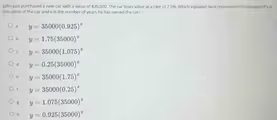
The correct answer is y = 35000(0.925)^x.
This problem requires creating an equation to model exponential decay, which describes a quantity decreasing at a constant percentage rate over time. The standard mathematical formula for exponential decay is y = A(1 – r)^x. Understanding each part of this formula is key to finding the correct solution.
In this formula, ‘y’ represents the final value after a certain period. ‘A’ stands for the initial amount or the starting value. ‘r’ is the rate of decay, which must be expressed as a decimal. Lastly, ‘x’ represents the number of time intervals that have passed, which in this case is the number of years.
According to the problem, the initial value of the new car, ‘A’, is $35,000. The car loses value, or depreciates, at a rate of 7.5% per year. To use this percentage in our formula, we need to convert it into a decimal by dividing it by 100. This calculation gives us r = 7.5 / 100 = 0.075.
The core of the exponential decay formula is the decay factor, calculated as (1 – r). This factor represents the proportion of the value that remains after each time period. For this car, the decay factor is 1 – 0.075 = 0.925. This means that each year, the car retains 92.5% of its value from the previous year.
By substituting the initial value (A = 35000) and the calculated decay factor (0.925) into the standard formula, we arrive at the correct equation: y = 35000(0.925)^x. This equation accurately models the value of the car, ‘y’, after ‘x’ years. Other options are incorrect because they either represent growth (using a factor greater than 1) or have an incorrect structure.