The Correct Answer and Explanation is:
The correct answer is w = 9 millimeters.
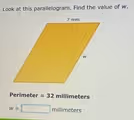
To determine the value of w, we must use the properties of a parallelogram and the definition of perimeter. A key characteristic of any parallelogram is that its opposite sides are equal in length. In the figure provided, one side has a length of 7 mm. This means the side directly opposite it must also be 7 mm long. The other side is labeled with the variable w, which means the side opposite it also has a length of w.
The perimeter of a shape is the total distance around its exterior. It is calculated by adding the lengths of all its sides. The problem states that the perimeter of this parallelogram is 32 millimeters. We can set up a mathematical equation to represent this information. The sum of the four sides is equal to the perimeter:
7 + w + 7 + w = 32
We can simplify this equation by combining the known numbers and the variables. Adding the two known sides gives us 7 + 7 = 14. Combining the two unknown sides gives us w + w = 2w. Now, our simplified equation is:
14 + 2w = 32
To solve for w, we need to isolate it. First, we subtract 14 from both sides of the equation to find the combined length of the two remaining sides.
32 – 14 = 18
This leaves us with the equation:
2w = 18
This equation tells us that two sides of length w add up to 18 mm. To find the length of a single side w, we divide 18 by 2.
18 / 2 = 9
Therefore, the value of w is 9. Since the lengths are given in millimeters, the final answer for the length of side w is 9 millimeters.