The Correct Answer and Explanation is:
Here are the correct matches for the quotes and their literary devices.
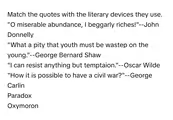
Oxymoron: “O miserable abundance, I beggarly riches!” John Donne
Paradox: “What a pity that youth must be wasted on the young.” George Bernard Shaw
Paradox: “I can resist anything but temptation.” Oscar Wilde
Oxymoron: “How it is possible to have a civil war?” George Carlin
Explanation
The key difference between these two literary devices lies in their structure. An oxymoron combines two directly contradictory words into a single, compact phrase. A paradox, on the other hand, is a full statement or idea that appears self-contradictory but contains a deeper, often profound, truth upon reflection.
The quotes from John Donne (often misattributed to Donnelly) and George Carlin are examples of oxymoron. In “O miserable abundance, I beggarly riches!,” Donne creates two oxymorons. “Miserable abundance” and “beggarly riches” are jarring phrases because abundance and riches are typically associated with happiness, not misery or the state of a beggar. The power of the device comes from this immediate clash of words. Similarly, George Carlin’s question points directly to the oxymoron within the term “civil war.” The word “civil” suggests politeness and order among citizens, which is the complete opposite of “war,” an act of violent, organized conflict. The two words are fundamentally at odds, making the phrase an oxymoron.
In contrast, the quotes from George Bernard Shaw and Oscar Wilde are paradoxes. Shaw’s statement, “What a pity that youth must be wasted on the young,” seems illogical at first. How can youth be given to anyone but the young? The underlying truth, however, is that young people often lack the wisdom and perspective that come with age to fully appreciate the gift of their own youth. Oscar Wilde’s famous line, “I can resist anything but temptation,” is a witty paradox that reveals a truth about human nature. The statement is logically absurd because the sole purpose of resistance is to overcome temptation. By saying he cannot resist temptation, he is humorously admitting that he has no self control at all. Both of these are complete statements whose initial absurdity gives way to a recognizable truth about the human experience.