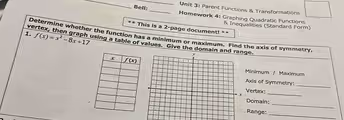
The Correct Answer and Explanation is:
Here are the correct answers and the explanation for the problem shown in the image.
Answers:
Minimum / Maximum: Minimum
Axis of Symmetry: x = 4
Vertex: (4, 1)
Domain: (-∞, ∞)
Range: [1, ∞)
Table of Values:
x=2, f(x)=5
x=3, f(x)=2
x=4, f(x)=1
x=5, f(x)=2
x=6, f(x)=5
Explanation
The problem asks for a complete analysis of the quadratic function f(x) = x² – 8x + 17. This function is in the standard form f(x) = ax² + bx + c, where a = 1, b = -8, and c = 17.
First, we determine if the function has a minimum or a maximum value. This is dictated by the coefficient ‘a’. Since ‘a’ is 1, which is a positive number, the parabola opens upwards. A parabola that opens upwards has a lowest point, so the function has a minimum value.
Next, we find the axis of symmetry, which is the vertical line that divides the parabola into two mirror images. The formula for the axis of symmetry is x = -b / (2a). Plugging in our values, we get x = -(-8) / (2 * 1), which simplifies to x = 8 / 2, so the axis of symmetry is the line x = 4.
The vertex is the turning point of the parabola and it lies on the axis of symmetry. We already have its x-coordinate, which is 4. To find the y-coordinate, we substitute this x-value back into the function: f(4) = (4)² – 8(4) + 17. This calculates to f(4) = 16 – 32 + 17, which equals 1. Therefore, the vertex is located at the point (4, 1).
To graph the function, we create a table of values centered around the vertex. We already know the point (4, 1). We can choose x-values on either side of 4, such as 3 and 5. For x=3, f(3) = (3)² – 8(3) + 17 = 9 – 24 + 17 = 2. Due to symmetry, the value for x=5 will also be 2. These points, (3, 2) and (5, 2), can be plotted.
The domain of a quadratic function is the set of all possible x-values. Since you can substitute any real number for x, the domain is all real numbers, expressed in interval notation as (-∞, ∞).
The range is the set of all possible y-values. Since the parabola opens upwards from its minimum point at the vertex (4, 1), the lowest y-value is 1. The y-values then extend infinitely upwards. The range is therefore all real numbers greater than or equal to 1, written as [1, ∞).