The Correct Answer and Explanation is:
The correct answer is 4.82.
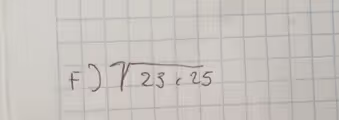
The image displays a mathematical problem asking for the square root of 23.25. The expression is written as F) followed by a radical symbol (√) covering the number “23,25”. In many regions outside of the United States, a comma is used as a decimal separator, so the problem is to calculate √23.25.
To find the square root of 23.25, we are looking for a number that, when multiplied by itself, gives 23.25. We can solve this by first converting the decimal into a fraction, which often simplifies the process. The number 23.25 is equivalent to the fraction 2325/100.
So, the problem becomes finding the square root of √(2325/100). Using the properties of square roots, we can separate the fraction into the square root of the numerator divided by the square root of the denominator: √2325 / √100.
The denominator is easy to calculate: √100 = 10.
For the numerator, we need to simplify √2325. We can do this by finding its prime factors or looking for perfect square factors. Since the number 2325 ends in 25, we know it is divisible by 25, which is a perfect square (5²). Dividing 2325 by 25 gives 93. So, we can rewrite 2325 as 25 × 93.
Now, we can simplify the numerator: √2325 = √(25 × 93) = √25 × √93 = 5√93.
Substituting this back into our expression, we get (5√93) / 10. This fraction can be simplified by dividing both the numerator and the denominator by 5, which results in (√93) / 2. This is the exact and most simplified form of the answer.
Since 93 has no perfect square factors (its prime factors are 3 and 31), √93 is an irrational number. For a practical numerical answer, we calculate its decimal value. The square root of 93 is approximately 9.64365. Dividing this by 2 gives approximately 4.8218. Rounding to two decimal places, the solution is 4.82.