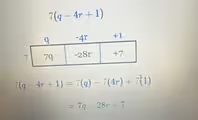
The Correct Answer and Explanation is:
Of course. Here is the correct answer and a detailed explanation.
Correct Answer: 7q – 28r + 7
Explanation
The problem presented, 7(q – 4r + 1), is an application of the distributive property in algebra. This fundamental rule states that a number multiplying a group of terms in parentheses must be multiplied by each individual term inside those parentheses. The image correctly demonstrates the process, although its final line omits the necessary plus and minus signs.
Here is a step by step breakdown of how to arrive at the correct answer:
- Identify the Terms: First, recognize the individual terms inside the parentheses. It is crucial to include the sign with each term. The terms are q, -4r, and +1. The number outside the parentheses is 7.
- Distribute to the First Term: Multiply the outer number (7) by the first term inside the parentheses (q).
7 * q = 7q - Distribute to the Second Term: Next, multiply the outer number (7) by the second term (-4r). A positive number multiplied by a negative number results in a negative product.
7 * (-4r) = -28r - Distribute to the Third Term: Finally, multiply the outer number (7) by the third and final term (+1).
7 * 1 = 7 - Combine the Results: Now, you combine the results from each multiplication to form the final expression. You simply write them one after another, keeping their signs intact.
The results were 7q, -28r, and +7.
Putting them together gives you the final, simplified expression: 7q – 28r + 7.
The terms in this final answer cannot be combined further because they are not “like terms”; one contains the variable q, one contains r, and one is a constant. The process shown in the image with the area model visually confirms this, as each box (7q, -28r, +7) represents a separate, distinct part of the final answer.