The Correct Answer and Explanation is:
Based on the provided diagram, here is the correct sequential matching of the labels to the biological process of hormone function.
Correct Answer
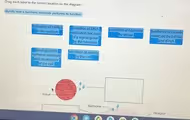
- Production of hormone by the endocrine gland: This label corresponds to the process occurring inside the red source cell.
- Secretion of hormone and its entrance into the bloodstream: This describes the hormone molecules leaving the source cell.
- Transport of hormone by the bloodstream: This label applies to the pathway between the source cell and the target cell, labeled “Bloodstream.”
- Hormone binds to specific receptors on the target cell: This action occurs where the hormone molecule meets the large rectangular target cell at the site marked “Receptor.”
- Binding of the hormone stimulates a response in the target cell: This is the resulting action that occurs within the target cell after the hormone has bound to the receptor.
- Hormone is broken down and excreted: This is the final step in the hormone’s life cycle, terminating the signal.
Explanation
The diagram illustrates the mechanism of endocrine signaling, which is how hormones function to regulate various physiological processes in the body. This is a multi step journey that ensures a specific message is delivered from a source to a distant target.
The process begins with the production of the hormone by specialized cells located within an endocrine gland, represented by the red circular cell. Once synthesized, the hormone is released from the cell in a process called secretion, entering directly into the circulatory system.
Next, the hormone undertakes its journey through the body via the bloodstream, which acts as a transport system. This allows the hormone to travel long distances from the endocrine gland to potentially any cell in the body. However, the hormone will not affect every cell it passes. Its action is highly specific due to the nature of the target cells.
A hormone can only influence a cell that possesses a specific receptor protein that matches the hormone’s molecular shape, similar to a lock and key mechanism. The diagram shows the hormone arriving at a target cell and binding to its specific receptor on the cell’s surface.
This binding event is the critical moment of communication. It triggers a cascade of biochemical reactions inside the target cell, leading to a specific cellular response. This response could be a change in metabolism, the activation of certain genes, or the secretion of another substance. Finally, to ensure bodily functions are precisely regulated, the signal must be terminated. The hormone is eventually broken down, typically by enzymes in the liver or blood, and its byproducts are excreted from the body, often through the kidneys. This entire sequence allows for precise, long distance communication and control, which is essential for maintaining homeostasis.