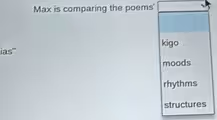
The Correct Answer and Explanation is:
The correct answer is structures.
Explanation
When comparing poems, analyzing their structures provides a deep and comprehensive understanding of the poets’ craft and intent. The term “structure” is a broad category that encompasses several key elements of a poem, making it the most likely focus for a detailed comparison. This includes the poem’s form, such as whether it is a sonnet, a ballad, or free verse. It also involves examining the rhyme scheme, the meter or rhythm, and the organization of lines into stanzas.
The visible text in the image strongly suggests one of the poems is Percy Bysshe Shelley’s “Ozymandias,” a work famous for its unique structure. “Ozymandias” is a sonnet, a form that traditionally has a very rigid structure. However, Shelley masterfully deviates from the standard Petrarchan or Shakespearean sonnet forms, creating a hybrid rhyme scheme. This deliberate choice is not accidental; the fractured, unconventional structure of the sonnet mirrors the poem’s central theme of decay and brokenness. The form of the poem reflects the “shattered visage” of the statue and the fragmented legacy of the once mighty king.
By comparing the structure of “Ozymandias” to another poem, a student like Max can explore how different poets use form to support their message. For instance, comparing it to a traditional Shakespearean sonnet would highlight Shelley’s subversion of convention. While comparing “moods” or “rhythms” are valid analytical points, they are often components of the larger structure. The structure is the foundational architecture upon which the mood and rhythm are built. The term “kigo” is specific to Japanese poetry like haiku and is irrelevant here. Therefore, comparing the poems’ structures offers the most thorough and insightful level of literary analysis.