The correct Answer and Explanation is:
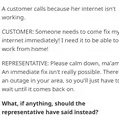
A better response from the representative would be:
“I’m so sorry to hear you’re dealing with this. I understand how critical it is to have your internet working, especially when you work from home. Let me look into this for you right away.
After checking your address, I can confirm there is a service outage impacting your neighborhood. Our technical team is already aware of the issue and is actively working on a resolution. The current estimated time for service to be restored is [e.g., 4:00 PM today]. I know this is not the news you wanted to hear, and I sincerely apologize for the disruption to your workday. What I can do for you right now is add you to our notification list, so you’ll receive a text message the moment your service is back online. We can also discuss applying a credit to your account for the downtime once the issue is fully resolved.”
Explanation
The original representative’s response failed because it was dismissive, confrontational, and unhelpful. The primary goal in customer service, especially with a frustrated customer, is to deescalate the situation and build rapport, not to create more conflict.
The phrase “Please calm down” is one of the worst things a representative can say. It invalidates the customer’s feelings and comes across as condescending, which often makes the person even angrier. A better approach is to validate their frustration with empathetic statements like “I understand how critical this is.”
Secondly, the original response offered no solution or ownership. Phrases like “isn’t really possible” and “you’ll just have to wait” are passive and place the burden entirely back on the customer. This makes the customer feel powerless and abandoned.
The improved response, in contrast, immediately takes ownership and demonstrates a commitment to helping. It begins with an apology and empathy, which builds a bridge with the customer. It provides clear, specific information, including the crucial detail of an estimated time of restoration. This manages the customer’s expectations and gives them a tangible timeline to work with.
Most importantly, the new response offers proactive solutions. By offering to set up text notifications and mentioning a future account credit, the representative gives the customer concrete next steps and demonstrates that the company values their business. This transforms the interaction from a frustrating dead end into a managed problem with a clear path forward, helping to retain the customer’s loyalty despite the inconvenience.