The Correct Answer and Explanation is:
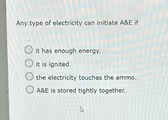
The correct answer is: it has enough energy.
Explanation
The initiation of Ammunition and Explosives (A&E) by an electrical source is fundamentally a matter of energy transfer. All explosive materials, particularly the sensitive primary explosives found in primers and detonators, are designed to remain stable until they absorb a specific minimum amount of energy. This is known as the activation energy or initiation threshold. If an electrical source can deliver energy that meets or exceeds this threshold, it can trigger the explosive’s chemical reaction.
This principle applies to all forms of electricity. A small static discharge, for example, can carry thousands of volts but may have very low total energy, measured in joules. For many types of A&E, this small spark might not be enough to cause initiation. However, for highly sensitive primary explosives, even this minimal energy can be sufficient. Conversely, a source like a faulty electrical wire or a lightning strike carries a massive amount of energy, making it a significant hazard capable of initiating even less sensitive main charge explosives. The critical factor is not the voltage, the current, or the type of electricity itself, but the total energy delivered to the sensitive component.
The other options are incorrect for specific reasons. The idea that electricity must “touch” the ammo is an oversimplification; an electrical arc can jump a gap to transfer energy without direct contact. The statement “it is ignited” is nonsensical, as electricity is the source of ignition, not something that is itself ignited. Lastly, while storing A&E tightly together is a major safety concern related to sympathetic detonation (where one explosion triggers others), it does not describe the condition needed for the initial electrical initiation. Therefore, the presence of sufficient energy is the universal requirement for any electrical source to initiate A&E.