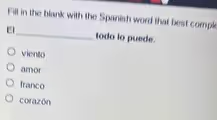
The Correct Answer and Explanation is:
The correct answer is amor.
The completed sentence is “El amor todo lo puede.” This is a very common and powerful proverb in the Spanish language, which translates idiomatically to “Love conquers all” or more literally to “Love can do everything.” It conveys the profound belief that love is a supreme force, capable of overcoming any obstacle, enduring any hardship, and achieving what might seem impossible. This sentiment is universal and is found in countless works of literature, poetry, and music across different cultures.
The phrase has ancient roots and is the direct Spanish equivalent of the Latin expression “Amor vincit omnia,” which was famously written by the Roman poet Virgil. Its persistence through centuries highlights the timeless and universal nature of the idea it represents: that love, in its purest form, holds a transformative power that transcends barriers of time, distance, and conflict.
Let’s analyze why the other options are not the best fit for this well known expression.
- Viento means “wind.” While one could say “El viento todo lo puede” (“The wind can do everything”) in a poetic or meteorological context to describe the destructive force of a hurricane, it is not a standard philosophical proverb.
- Franco is typically an adjective meaning “frank” or “sincere.” As a noun, it does not fit grammatically or semantically in this sentence.
- Corazón means “heart.” “El corazón todo lo puede” (“The heart can do everything”) is a plausible and poetic phrase, as the heart is often seen as the seat of courage and emotion. However, the established proverb specifically uses the word “amor” to refer to the abstract concept of love itself as the all powerful entity, making it the most culturally and linguistically appropriate answer.